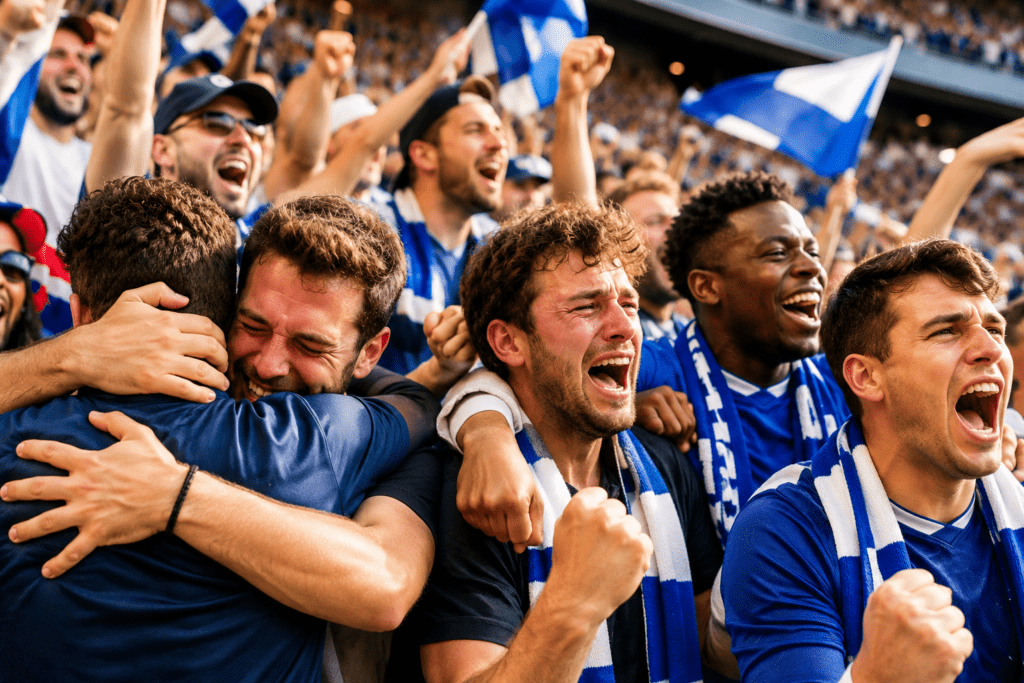
Growing up loving soccer/football, I always knew there was something special about the sport. The emotion it evokes is like no other; it’s an anxiety I enjoy. Watching your nation on the biggest stage is a feeling that cannot be replicated. I had the privilege of supporting both my nations, England and Switzerland, on the biggest stage. Switzerland’s best moments came not in the World Cup, but in the Euros, the World Cup equivalent for European teams, where we fought back with 10 minutes left, down 3-1 against France, to level the score 3-3 and win on penalties, sending us to our first quarterfinal in decades. It was a moment of pure euphoria where I could scream and yell without fear of judgment. Similarly, in 2018, when England were on the brink of their first World Cup final in 52 years, Kieran Trippier’s free kick four minutes in brought pure jubilation; in that moment, it had an entire nation believing we could maybe, just maybe, do it. However, jubilation soon turned to despair and tears as England bowed out to Croatia in extra time. Tears, I tell you, for what could’ve been for us. The highs and lows of football mirror those we experience in life, and perhaps this is why we love the game so much.
It’s moments like this when I reflect: Why are men able to express themselves so easily in sport without judgment? Grown men crying in sport are rarely seen as weak. Yet, outside of that, it is? What is the paradox? There’s an article that discusses this in detail, and its findings are fascinating. The study had men look at images of firefighters and nurses crying and rate whether crying was socially appropriate (MacArthur, 2019). Interestingly, the study found that men’s ratings were influenced by gender stereotypes about what is considered masculine (MacArthur, 2019). So, when they saw images of firefighters crying, men deemed it more appropriate than seeing male nurses cry (MacArthur, 2019). Thus, when we look at sports as a very masculine sort of thing, it’s the only appropriate time men are allowed to express ourselves without being judged, whether by women or other men.
It’s accepted in society to be excited, angry, or upset about sports because it’s considered masculine, even though it is tied to emotion; it’s in a masculine environment. This continues the point about how acceptable it is for certain jobs to express emotion. For example, the firefighter is allowed to express his emotions because of the traumatic experiences he endures, and society excuses that for men. Similarly, at weddings, men are allowed to express emotion without judgment. When we look at weddings, it’s perhaps not often that men are allowed to publicly express their feelings of love in a relationship, at least on social media, because of how society perceives it.
Men are supposed to be the ones who hold it together, which is why men are not allowed to express themselves publicly in relationships. There’s this unconscious stigma that men need to be the provider and hold the household together, but once men reach their wedding day, they are forced to process what’s happening without distraction, which is perhaps what causes men to cry and why it’s acceptable. My theory is also that men, seeing their partner walk down the aisle, remind them of all the trials and tribulations they’ve been through in order to get to that moment, which causes a huge surge of emotion and may be a source for them to finally express repressed emotions and reflect on the relationship, where maybe other times they wouldn’t.
What do these two examples ultimately show us? Men’s emotional expression is not truly suppressed; it is redirected and selectively permitted within contexts deemed masculine. The issue isn’t an inability to feel, but rather that men are taught their emotions only matter when legitimized by the situation. To fully understand this, we also have to examine its impact on women. The society that encourages men to restrain their emotions until the right masculine context arises imposes a very different, yet parallel, expectation on women, not a deficit of emotional expression, but an excess.
Famous sociologist Arlie Hochschild (1983) wrote in her book The Managed Heart about the concept of emotional labor, the effort to manage feelings in accordance with social and professional demands (Hochschild, 1983). The examples I want to highlight relate to employment. She uses flight attendants as an example of individuals required to exude warmth and cheerfulness regardless of their true emotions, because their smiles are part of their job (Hochschild, 1983). She contrasts this with debt collectors, who are expected to display coldness and intimidation to pressure people to pay their debts; once again, emotional performance is shaped by professional norms (Hochschild, 1983).
She argues that this constant management and performance of emotion falls most heavily on women, not just at work, but also at home and in relationships, where it often goes unseen and unacknowledged (Hochschild, 1983).
While men in society are waiting for the “right” context to express feelings, women are expected to continually regulate, perform, and smooth over emotions for the benefit of others, almost always without recognition or respite. These aren’t isolated problems; they’re symptoms of the same social system, experienced in gendered ways.
Every four years, the World Cup offers a rare window in time, something we spend much of our lives hiding. We see grown men openly weep in stadiums, strangers embrace in the streets and on the stands, and, for a brief moment, an entire nation shares its emotions without shame or judgment.
Yet, as soon as the final whistle blows and the fans part ways, this collective permission to feel vanishes. The jerseys are folded away, and with them goes the freedom to express vulnerability. This is the paradox at the heart of men’s emotional lives: the capacity for deep feeling is always present, but it is legitimized only in certain settings. Sport, with its strong masculine associations, grants that permission. But true humanity shouldn’t be confined to a stadium, a sport, or a job.
The World Cup doesn’t just reveal the intensity of men’s passion for the beautiful game; it also shows how they seek opportunities to express themselves and share joy, and how rarely society allows them to do so outside of sport. Most importantly, this permission is built on the same social structure and foundation that silently expects women to bear the emotional burdens of relationships, jobs, and everyday life while men wait for the next real moment or match. Real progress means more than giving men brief outlets like the World Cup; it requires us to create a society in which everyone, regardless of gender, can express themselves freely, without needing masculinity to justify their expression. Let the games begin, and enjoy the beautiful game, I know I will.
At Avedian Counseling Center a safe space to navigate through masculinity and gender roles, Avedian Counseling Center offers individual and couples therapy in Sherman Oaks, Woodland Hills, Glendale, Pasadena, and Los Angeles. Telehealth is also offered to residents within California. Nicholas Schaub is also available for presentations and podcasts that discuss masculinity and gender roles.
References
Hochschild, A. R. (1983). The managed heart: Commercialization of human feeling. University of California Press.
MacArthur, H. J. (2019). Beliefs about emotion are tied to beliefs about gender: The case of men’s crying in competitive sports. Frontiers in Psychology, 10, 2765. https://doi.org/10.3389/fpsyg.2019.02765

Nicholas Schaub is an Associate Marriage and Family Therapist dedicated to supporting clients on their path toward healing and growth. He holds an undergraduate degree in Psychology with a minor in Entrepreneurship, as well as a master’s degree in clinical psychology with an emphasis in Marriage and Family Therapy, both from California Lutheran University. Having lived in Thailand, the Philippines, the United Kingdom, and the United States as a third-culture kid, Nicholas brings a deep appreciation for cultural diversity and adaptability to his practice. His global upbringing fosters a culturally sensitive and open approach, enabling strong connections with clients from diverse backgrounds. Aiming to break the stigma around men seeking therapy, Nicholas is committed to offering a safe, inclusive environment where clients of all genders and backgrounds can share openly and feel genuinely supported.