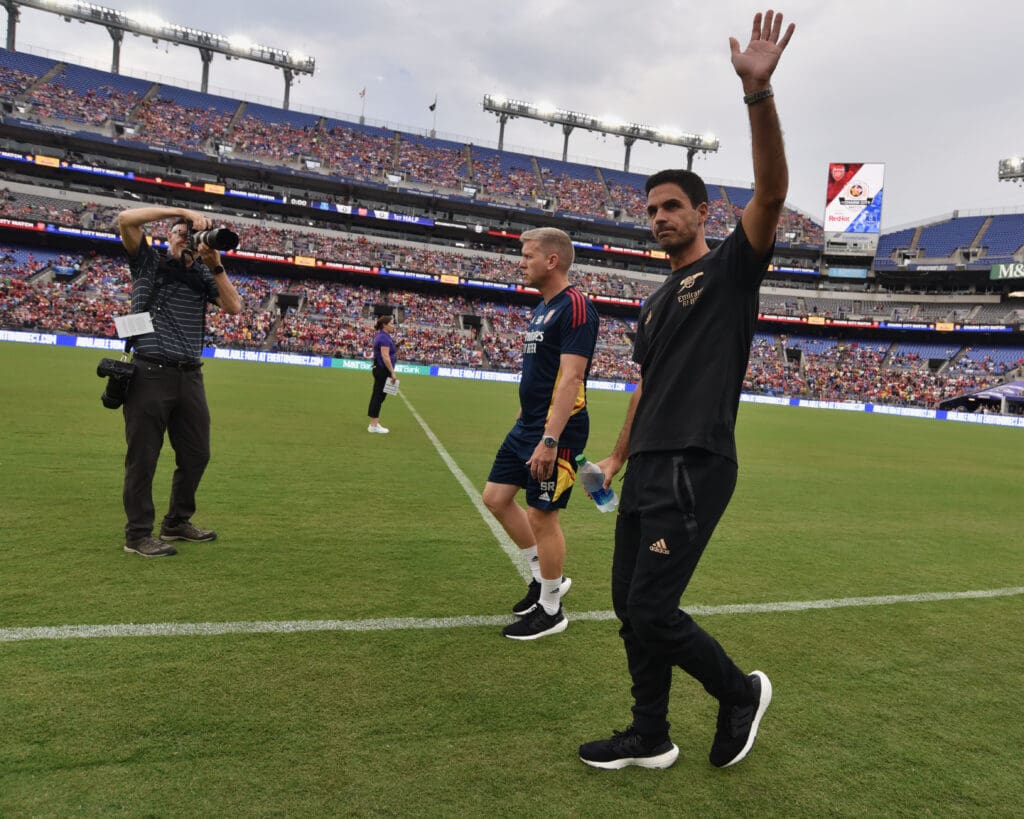
Arriving at his former club, where he once played, Arteta inherited a depleted and beaten Arsenal team. For years, Arsenal had the reputation of being ‘bottle jobs’ (they always got so close to winning the league but collapsed under pressure). And for 22 years, this was true, having no Premier League title to show. So, how did Arteta psychologically change and reshape Arsenal from a side known as ‘bottle jobs’ into winners? He changed the narrative at the club when he arrived. Arteta’s journey is not just about football; it offers valuable insights into overcoming setbacks and reshaping our own stories. How is this connected to therapy? In life, we tell ourselves stories about who we are and what we mean. Over time, these narratives shape our core beliefs, influence our identity, and affect how we respond to challenges. Part of narrative therapy is reauthoring your story, and Arteta did that at Arsenal Football Club.
The Issue – A Narrative That was Destructive
Their problem-saturated story was that they were the bottle jobs, the team that would always start strong but end up with nothing. This identity was reinforced by fans and the broader football culture. When you have a problem-saturated story, it becomes ingrained in the players, much as it would in therapy for an individual. To resolve this in narrative therapy, we call this externalizing the problem. Instead of telling his team they are bad players, he doesn’t blame the individual. He understands there is pressure from fans, as well as doubt, fear, and insecurity, as he expressed in one of his most famous speeches.
The Reframe – Changing the Narrative
After the Manchester City game, a tough loss for the team that led to poor performances in the league and back-to-back defeats, morale was low, and Arteta’s job was on the line. Arteta told his team he was at an all-time low and struggled with the defeat. But then he did something interesting: he connected this message to a doctor who treated him as a child when he had a heart condition. For two years, doctors worked to save his life until he was able to have surgery. Arteta used this story to explain that high-performance teams are not limited to football. Doctors, players, staff, and others can all exemplify high performance when they work together to achieve results. Why do high-performance teams excel? Because they genuinely love what they do, that’s their purpose and reason.
Even after that game, when he was at an all-time low, Arteta said he remembered the positives: the supportive owners, his family, and the great group of players around him. It was the players who made him realize that, in his toughest moment, they were his purpose. He thanked them for turning a difficult time into the best moment of his career. He explains that, in challenging moments, he remembers why he wants to be a coach and how these experiences remind him that he loves what he does, despite the obstacles. This shift in mindset became a powerful reframing, allowing him to focus on gratitude, purpose, and support rather than just failure and disappointment.
How to Overcome Challenges
We can do the same thing in our own lives: look at the challenges but also reflect on what we’re grateful for. When you experience setbacks, try listing three things you are grateful for. Even when a situation is tough, there are still good things that can come from it, and we can persevere. It’s about changing our story and our perspective.
This connects to narrative therapy thinking because Arteta gives a painful experience new meaning. Instead of allowing the Manchester City loss to become a story of failure, he re-authors it into a story about purpose, gratitude, resilience, and love for the work. It’s also an example of reframing and cognitive behavioral therapy. He takes a moment that many of us could see as negative and turns it into a positive. In turn, this helps his team get results. They were expecting to be yelled at and blamed, but he did the exact opposite, which improved performance. This is something we can do as individuals as well. When we blame ourselves, we fall short of achieving our goals. We struggle to get results because we focus on the negatives rather than the positives. We all make mistakes, we’re human, and acknowledging that we can make mistakes, but still get back up and continue to achieve our goals despite the setbacks.
Arteta uses meaning-making through symbols, stories, and vulnerability. For example, he planted a 150-year-old olive tree to represent Arsenal’s roots, growth, and evolving club culture (Aarons, 2026). He also adopted a dog for the club and named it Win, symbolizing the team’s desire to win and reinforcing a positive, united environment within the club. However, one of the most powerful examples of meaning-making is Arteta’s own vulnerability. He openly questioned his own leadership and wondered whether he was capable of leading the team forward (Aarons, 2026). Instead of allowing those doubts to define him, he reframed them through resilience and purpose. He created a new narrative that, despite setbacks and disappointments, the team would continue to fight, grow, and move toward their goal. Through this, Arteta turns struggle into meaning and helps the team see adversity as part of their larger story rather than the end of it.
Changing the Narrative
As individuals, we can learn from Arteta that our stories are not defined by our setbacks. Instead, setbacks provide a valuable backdrop to reflect on when we achieve our goals. These setbacks don’t define us; they are part of our story and our development. When we struggle, we can remember to change our narrative, focus on what we can control, and stay mindful of where we are going and how we intend to get there. We should never let our past define us; rather, we can use it as motivation to move forward and create a new story that aligns with our goals and purpose.
Self-Reflection
We can do the same thing: reflect on a recent setback in your life. What did you learn from it? Describe what happened. What do you want to do moving forward? What did you appreciate about yourself in that moment? This is a great way to practice narrative therapy and to re-author your own story while still acknowledging the mistake and reflecting on how you want to move forward.
Aarons, E. (2026, May 21). Mikel Arteta was ‘in the garden building a fire’ when Arsenal won
Premier League title. The Guardian.
Speech high-performance teams – https://www.youtube.com/watch?v=13dSuAfhEds

Nicholas Schaub is an Associate Marriage and Family Therapist dedicated to supporting clients on their path toward healing and growth. He holds an undergraduate degree in Psychology with a minor in Entrepreneurship, as well as a master’s degree in clinical psychology with an emphasis in Marriage and Family Therapy, both from California Lutheran University. Having lived in Thailand, the Philippines, the United Kingdom, and the United States as a third-culture kid, Nicholas brings a deep appreciation for cultural diversity and adaptability to his practice. His global upbringing fosters a culturally sensitive and open approach, enabling strong connections with clients from diverse backgrounds. Aiming to break the stigma around men seeking therapy, Nicholas is committed to offering a safe, inclusive environment where clients of all genders and backgrounds can share openly and feel genuinely supported.